Three lakes. One guided road trip day.
This Banff Big 3 tour is built for huge scenery with air-conditioned comfort and pickup options that keep you from wrestling rentals, parking, and route stress. You’re in a small group (max 13), you get park admission handled, and the stops are timed so you can actually enjoy each place instead of just snapping and sprinting.
What I love most is the way the tour feels run by people who know the area, down to what to notice and how to pace your time. I especially liked the guide-led detail—from geology and wildlife to first-explorer and development stories—plus the fact that the day includes real comfort touches like snacks and pop, not just a seat on a bus. Cassie, Bryce, Max, and Randi are names that show up again and again in the guide lineup, and that same friendly, organized vibe is exactly what you want on a packed day.
One thing to consider: this is a long, early-start day, and lunch isn’t included, so plan for your energy level.
In This Review
- Quick hits before you go
- The day in plain terms: early pickup, long views, steady pacing
- Lake Louise: icon views, plus the why behind the postcard
- Moraine Lake in the Valley of the Ten Peaks: the sapphire-blue moment
- Emerald Lake: glacier chemistry you can actually understand
- Takakkaw Falls: the “magnificent” waterfall stop that surprises people
- What you get for the price: transport, park access, and guided use of time
- Guide-led experience: names you’ll hear and what they do well
- Who should book this Banff Big 3 with Big Nature
- Should you book? My practical take
- FAQ
- What is the duration of the Banff Big 3 Moraine Lake, Lake Louise and Emerald Lake Tour?
- How much does the tour cost?
- Where are the pickup options in Calgary, and what’s the meeting point?
- What are the typical pickup time windows from different areas?
- What stops are included on this tour?
- Is park admission included?
- What’s included in the tour package?
- Is lunch included?
- Are car seats included for children?
- What’s the group size limit?
- Is free cancellation available?
Quick hits before you go
- Small group (max 13): more breathing room at photo stops than big buses.
- Free park access built in: park admission is included, and each stop lists admission as free.
- Real timing + photo help: guides give advice on where to stand and how to use your limited time well.
- Four major highlights: Lake Louise, Moraine Lake, Emerald Lake, plus Takakkaw Falls.
- Curated nature + stories: glaciers, sediment, and waterfalls, explained in plain language.
- Comfort extras: light snacks and soda/pop on the ride.
The day in plain terms: early pickup, long views, steady pacing
This is a 7 to 10 hour outing that’s designed as a full-on driving day through Banff and Yoho, not a slow stroll with long sits. The start time is 7:00 am, and pickup times depend on where you’re coming from. If you’re in Calgary, your pickup window is roughly 6:30–7:00 am (from the NW meeting point at 8235 Bowridge Crescent NW). If you’re closer, expect later pickups: Canmore around 8:15 am, Banff around 8:40 am, and Lake Louise Village around 9:30–9:45 am.
Why that matters: these lakes are popular, and your best chances for photos and calmer viewing come from arriving at the right moments. A guide can’t control the weather or crowds, but they can help you show up ready and use your time efficiently at each stop.
Also, know your time will be “enough” but not “all day.” You’ll get about 1 hour at Lake Louise, 1 hour at Moraine Lake, about 45 minutes at Emerald Lake, and about 45 minutes at Takakkaw Falls. That schedule forces good choices: quick view points, smart walking, and grabbing photos without losing your whole hour.
If you’re hoping to add extra hikes, the day can sometimes be more active depending on the exact outing. In some versions, guides have built in additional walking like Lake Agnes, Big Beehive, or Sentinel Pass—so if you’re booking for active views, ask how much optional hiking is typical for your specific departure.
Lake Louise: icon views, plus the why behind the postcard
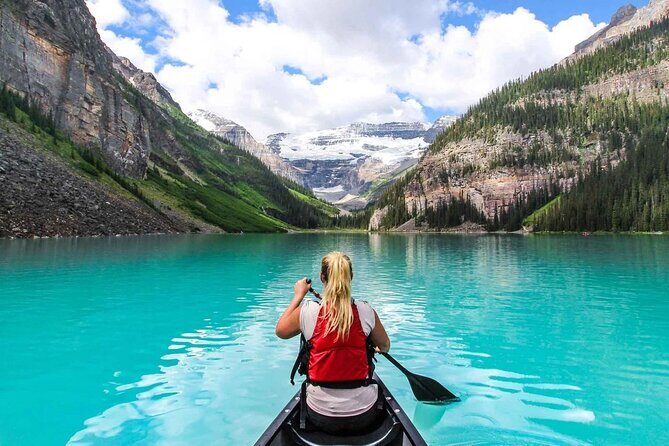
At Lake Louise, you’re stepping into a place with a lot more going on than water and mountains. The lake is known by the Stoney Nakota First Nations people as Ho-run-num-nay, which the tour materials connect to the idea of Lake of the Little Fishes. That’s the kind of small context that helps the scenery feel grounded, not just famous.
You’ll also see Chateau Lake Louise, a world-renowned mountain resort in Banff National Park and a UNESCO World Heritage Site. The Chateau was developed beginning in the late 1800s and is tied to the Canadian Pacific Railway hotel network. It shares hotel-family lineage with major rail-era icons like Banff Springs, plus Le Chateau Frontenac in Québec City and the Empress Hotel in Victoria. Even if you only glance at it from the lakeside paths, it’s worth knowing you’re looking at a whole chapter of how the Canadian West was built and promoted.
You’ll have about 1 hour here, and that’s the right amount for a relaxed loop: take in the wide mountain panorama, get your photos with the Chateau framing the scene, and then move on before your hour turns into a rushed sprint. If the weather shifts, Lake Louise can change fast—cloud cover can soften the contrast, and sunshine can make the water look almost unreal.
What to watch for: Lake Louise is a classic “arrive and choose” stop. If you try to do everything (views, photos, long walk, and a long sit), you’ll feel rushed. I like this stop when you treat it like a photography-and-stretch stop, not a meal-and-linger stop.
Moraine Lake in the Valley of the Ten Peaks: the sapphire-blue moment
Moraine Lake is famous for a reason. It’s set in the Valley of the Ten Peaks, and the water is often described as sapphire-blue—one of those colors that looks like it was mixed by a paint artist. You’ll have about 1 hour here, and that hour can be the highlight of the whole day if you pace yourself.
This stop is all about balance: you want the big wide views, but you also want to walk far enough to get angles that don’t all look the same. A good guide helps you do that quickly. The best part of a guided day here isn’t just someone pointing at a landmark—it’s advice that helps you use the limited time well.
A note on timing: some outings with this company include very early starts to catch sunrise at Moraine Lake. That kind of start isn’t always part of every departure, but it does explain why people describe this area as a “don’t-miss” moment. Even without sunrise, your guide’s job is to help you arrive with your plans ready.
Also, Moraine Lake is frequently photographed, so your strategy matters. I’d focus on getting a few strong shots from a couple of key viewing spots, then spend the rest of the time enjoying the scene without checking your phone every five minutes. It’s one of those places where your brain finally gets to relax.
Emerald Lake: glacier chemistry you can actually understand
Emerald Lake is where the tour gets quietly nerdy—in a good way. You’re in Yoho National Park, and this lake’s color story is explained in terms of glaciers, rock flour, and how light interacts with the water.
Here’s the simple version: glaciers once covered the area. As ice retreated, meltwater carried finely ground sediment (often called rock flour) downstream. That suspended material affects how light travels through the water. Combine that with the reflection of the blue sky, and you can get that famous green-blue look.
So yes, it’s pretty. But it’s also educational in a way that sticks, because it connects the color to something physical you can picture: glaciers grinding rock, sediment staying suspended, light scattering and reflecting. It’s not just trivia—it helps you see Emerald Lake as an active, ongoing process, not a static postcard.
You’ll have about 45 minutes at Emerald Lake. That’s plenty for a calm lakeside moment and a short walk for different angles, but it’s not meant for an all-day picnic. If you’re the type who likes to sit and soak it all in, plan on doing it in shorter bursts—view, photos, brief walk, then sit for a few minutes before you move.
Takakkaw Falls: the “magnificent” waterfall stop that surprises people
After the lakes, you get Takakkaw Falls, located in Yoho National Park near Field, British Columbia. The name Takakkaw translates to magnificent in Cree, which is a great cue for what you’re about to see.
This waterfall is huge: it drops a total height of 373 metres. That makes it the highest waterfall in the Canadian Rockies and the second highest in Canada. In other words, this is not a little scenic detour. It’s the kind of sight that makes your brain stop calculating and just stare.
You’ll have about 45 minutes here. That time window is meant to let you take in the full waterfall moment, not rush through it. Don’t over-plan. Instead, do one loop for angles, grab a few photos, then spend a couple of minutes simply watching the flow. Waterfalls are one of those things where the “moving part” becomes the main event.
What’s also nice: Takakkaw Falls breaks up the day. Lakes can feel similar after a while—big views, water, mountains. A waterfall gives you a totally different visual rhythm and a different kind of energy.
What you get for the price: transport, park access, and guided use of time
The price is listed at $179.59 per person, and that’s for a day that includes pickup options, private transportation, air-conditioned comfort, a light snack, and soda/pop, plus park admission. It also includes mobile ticketing and is offered in English.
You’re not paying only for the view. You’re paying for:
- Getting driven between far-flung stops without a rental car stress spiral
- Having someone coordinate timing so you don’t lose half your day figuring out parking
- Having the stops “unpacked” so you understand what you’re looking at
That’s why reviews consistently mention relief from driving and the value of a guide who knows the area well. In one described experience, the guide also helped with top parking and gave practical advice on where to stand for photos—exactly the type of detail that’s hard to DIY without spending hours on planning.
On what’s not included: lunch isn’t included, and car seats for children aren’t listed as included. So you’ll want to bring your own lunch or plan a stop on your route if that fits your schedule. Since you’ll be in transit for much of the day, it’s smart to pack extra water and a backup snack even though light snacks are provided.
Also, the tour notes that most travelers can participate. That doesn’t mean it’s stroller-flat everywhere, but it does suggest the day is designed with typical visitor walking in mind.
Guide-led experience: names you’ll hear and what they do well
Big Nature guides show up repeatedly in the reviews with the same pattern: they’re friendly, organized, and they explain things in a way that makes the scenery easier to enjoy. Guides mentioned include Cassie, Bryce, Max, and Randi.
What that tends to look like on the ground:
- Clear explanations at each stop, including how the land was formed
- Help with pacing your hour so you don’t miss the best viewpoints
- Wildlife-spotting and noticing what you might otherwise walk past
- Quick photo guidance so you don’t waste time experimenting too much
I like this type of guiding because it turns a checklist into a story. You’re not only seeing water and mountains—you’re learning why those colors exist, why those valleys look the way they do, and why certain places became famous.
And it’s not just talk. In multiple descriptions, the guides provide hydration and keep the vibe upbeat. If you’re doing a long day with early pickup, that kind of “we’ve got you” energy matters more than people expect.
Who should book this Banff Big 3 with Big Nature
This tour is a strong fit if:
- You want the big names—Lake Louise, Moraine Lake, Emerald Lake—without the driving grind
- You’d rather spend your brainpower on enjoying the views than on logistics
- You like guided storytelling that connects geology, history, and wildlife
- You appreciate a small-group experience with a real chance to breathe at each stop
It may not be the best match if:
- You need lots of downtime at one location
- You’re very sensitive to early mornings
- You expect lunch to be included (it isn’t)
Also, if you’re traveling as a family or with mixed energy levels, the group size cap (max 13) and inclusive spirit described in reviews can help. Still, check your own comfort level with walking, especially around lake viewpoints and waterfall areas.
Should you book? My practical take
If your goal is to see the Banff Big 3 plus a major Yoho waterfall in one day, this is the kind of tour that makes sense. The value isn’t just the low-ish ticket for the region—it’s that park admission and transport are handled, the group is small, and the guide helps you use your limited time well at the most famous places.
Book it if you’re happy with a full day schedule and you can plan for no lunch by bringing something you’ll enjoy. Skip it only if you want a slow travel pace or you’d rather control every timing choice yourself.
FAQ
What is the duration of the Banff Big 3 Moraine Lake, Lake Louise and Emerald Lake Tour?
The tour runs about 7 to 10 hours.
How much does the tour cost?
The price is listed as $179.59 per person.
Where are the pickup options in Calgary, and what’s the meeting point?
In Calgary, pickup starts from the NW meeting point at 8235 Bowridge Crescent NW, Calgary, AB T3B 3R6.
What are the typical pickup time windows from different areas?
Calgary pickup is roughly 6:30am–7:00am, Canmore about 8:15am, Banff about 8:40am, and Lake Louise Village about 9:30am–9:45am. Other pickup locations may be arranged within reason.
What stops are included on this tour?
The tour includes Lake Louise, Moraine Lake, Emerald Lake, and Takakkaw Falls.
Is park admission included?
Yes. Park admission is included, and each stop lists admission ticket free.
What’s included in the tour package?
Included items are a light snack, soda/pop, an air-conditioned vehicle, private transportation, and park admission. You’ll also have a mobile ticket and the tour is offered in English.
Is lunch included?
No. Lunch is not included.
Are car seats included for children?
Car seats for children are not included.
What’s the group size limit?
The maximum group size is 13 travelers.
Is free cancellation available?
Yes. You can cancel up to 24 hours in advance for a full refund.